
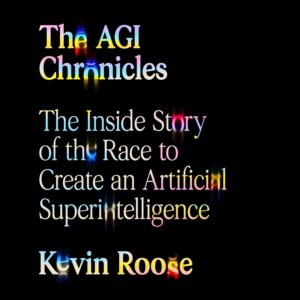
The AGI Chronicles
By Kevin Roose
Recommended on: 18th October 2026
I’m in the middle of Kevin Roose’s new book, The AGI Chronicles: The Inside Story of the Race to Create an Artificial Superintelligence—it is absolutely riveting. Roose covered the world of AI for The New York Times for years; for this book he interviewed more than 150 key players at OpenAI, Anthropic, and Google DeepMind. And so we learn the inside story of why Anthropic’s founders left OpenAI, of Sam Altman’s firing and rehiring, and of the officials in Washington who are trying to regulate a technology that changes faster than they (or we) can keep up. Roose compares the whole race to the Manhattan Project, but personally, I think it’s even bigger than that.
(Side note, speaking of the Manhattan Project, in the months right after World War II ended, my father flew atomic bomb test materials from Roswell, New Mexico, to Johnston Atoll in the Pacific—about twenty-two hours in the air, flown in stages. He did, that is, until one day the landing gear wouldn’t lock down after takeoff, so nobody knew whether the plane would crash when it tried to land. He had to circle Roswell for some twelve hours to burn off fuel, so that if the gear folded, the plane would at least be light and nearly dry when it hit. That’s a lot of time to think about maybe getting a different career—which is how he became a veterinarian. And how I learned interesting stories about Roswell, where my mother was from… Another time!)
Anyway, back to The AGI Chronicles. As it turns out, a surprising amount of Roose’s book is about learning. The labs train these models in part through reinforcement learning. Reward the model’s good answers and penalize its bad ones—this creates what is called a reward prediction error, meaning the difference between what the model expected to get and what it got. In 1996, Read Montague, Peter Dayan, and Terry Sejnowski (yes, our Learning How to Learn co-instructor) proposed that dopamine neurons in the brain compute that same reward prediction error. Their idea became the standard textbook account of what dopamine does. Thirty years later, neuroscientists are finding that the brain’s version is a good deal messier than the algorithm.
MORE INFORMATION FROM AMAZON.COM >Order The AGI Chronicles
You can order The AGI Chronicles, using a retailer below


